Why the Same Pre-Workout Snack Sits Heavy Some Days and Not Others
Quick Answer: Your stomach empties at wildly different speeds depending on the day, and the snack is rarely the variable. The five things that actually change it: how stressed you are (stress can slow gastric emptying by 30-50%), what you ate 3-5 hours earlier, how hydrated you are, the ambient temperature, and where you are in your menstrual cycle. Same food, same timing, different stomach. The fix is to adjust the gap and the texture, not to abandon the food.
Most people respond to one heavy session by permanently demoting a snack that was working fine. That is solving the wrong problem.

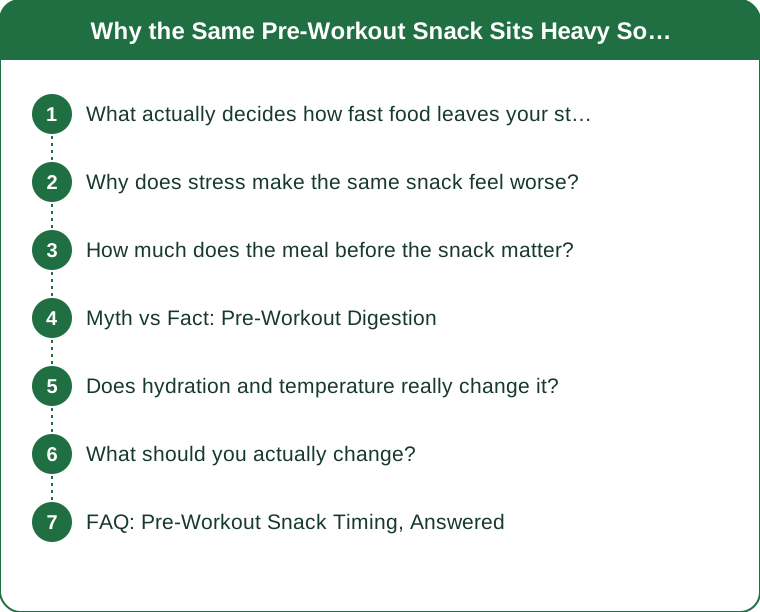
What actually decides how fast food leaves your stomach?
Gastric emptying is not a fixed rate. It is a regulated process, and the regulator changes settings daily.
Volume and calorie density set the baseline. Your stomach empties roughly 2-4 calories per minute for most mixed foods. A 200-calorie snack therefore needs somewhere between 50 and 100 minutes to clear - which is already a two-fold range before anything else varies.
Fat and fibre slow it down the most. A tablespoon of nut butter can add 30-45 minutes to the clearance time of an otherwise identical snack. Protein is intermediate. Simple carbohydrate with fluid clears fastest.
Liquid beats solid, every time. The same 200 calories as a smoothie clears substantially faster than as a bowl, because liquids bypass the grinding phase entirely.
The bit nobody accounts for: exercise itself slows gastric emptying once intensity passes roughly 70% of maximum. Blood flow is redirected away from the gut. So a snack that would have cleared comfortably at rest can sit in place once you start working hard - which is why it feels fine walking to the gym and awful in the third interval.
Why does stress make the same snack feel worse?
Because digestion is a parasympathetic process and stress is the off switch.
Sympathetic activation slows gastric emptying measurably. Under acute stress - a bad morning, a deadline, arguing in the car - emptying can slow by 30-50%. The snack you ate 60 minutes ago has done maybe 40 minutes of work.
This stacks with the exercise effect. A stressful day followed by a hard session is the combination that produces the worst outcomes, and it is exactly the day people are most likely to blame the food.
Poor sleep does the same thing. One short night raises circulating cortisol the next day and slows gut motility with it. This is a very common explanation for the Thursday brick after a bad Wednesday night.
What to do: on a day you know is stressful, switch the texture, not the food. The same banana and yogurt as a blended drink clears far faster than as a bowl, and you keep the fuel.
Five minutes of slow nasal breathing before eating is not a wellness platitude here - it genuinely shifts you toward the parasympathetic state that empties the stomach. Cheap, and it works.
How much does the meal before the snack matter?
More than the snack does, and almost nobody tracks it.
A large or fatty meal 3-5 hours before training is still in your stomach. A high-fat lunch can take 5-6 hours to clear. Adding a pre-workout snack at hour four is not adding to an empty stomach - it is stacking on a partly full one.
This is the single most common reason for the Tuesday-versus-Thursday difference. Same snack, same time, but Tuesday lunch was a salad and Thursday lunch was a burrito.
The practical rule: the bigger and fattier the previous meal, the smaller and simpler the pre-workout snack needs to be - or skip it. If lunch was substantial and you train at 6pm, you probably need water and maybe a piece of fruit, not a full snack.
Working the other direction: if you skipped lunch entirely, the snack lands on a genuinely empty stomach and clears fast, but you may need more of it than usual to get through the session.
Track this for two weeks - just the previous meal and whether the snack sat heavy. The pattern usually falls out immediately, and it is almost never about the snack itself.

Myth vs Fact: Pre-Workout Digestion
Myth: If a food ever sits heavy, it is the wrong food for you. Fact: Foods are not intrinsically incompatible with your stomach. The same food behaves differently depending on the conditions of the day. Demoting a food after one bad session usually costs you a perfectly good option.
Myth: You should always wait a fixed number of hours. Fact: The right gap varies from 30 minutes to 3 hours depending on size, composition, and how hard you are training. A fixed rule guarantees you get it wrong on both ends.
Myth: Fizzy drinks make it worse. Fact: Carbonation causes discomfort by adding gas volume, but it does not slow emptying meaningfully. It feels worse without being worse - though that distinction is not much comfort mid-set.
Myth: Training on an empty stomach is safer. Fact: It avoids the problem rather than solving it, and it costs you performance in anything longer or harder than about 45 minutes.
Myth: Heavy stomach means low fitness. Fact: It has nothing to do with fitness. Well-trained endurance athletes get this constantly - and hard training makes it more likely, not less.
Does hydration and temperature really change it?
Both, and both are underrated.
Dehydration slows gastric emptying. Being down even 2% of body weight in fluid measurably slows clearance. This is why the same snack sits heavy on a hot day, on a travel day, or after a night of drinking.
Fluid with the snack speeds it up. Roughly 300-500ml of water alongside a solid snack helps it clear rather than diluting anything. People often avoid drinking because they already feel full, which makes the problem worse.
Heat compounds everything. In hot conditions blood is diverted to the skin for cooling, and the gut gets less of it. A snack that clears fine at 18C can sit stubbornly at 30C.
As the weather turns cooler, most people find the same pre-workout snack starts working better than it did in July - and often needs to grow slightly, because appetite and training intensity both come back up.
Cycle timing matters too. In the luteal phase, progesterone slows gut transit and raises core temperature slightly. Many women find the same snack needs an extra 20-30 minutes in the week before a period. This is normal physiology, not a problem to fix.
What should you actually change?
Adjust in this order. Stop at the first one that works.
1. Widen the gap by 30 minutes. The cheapest fix, and it solves most cases. If 60 minutes is uncomfortable, try 90.
2. Change texture, not food. Blend it. A smoothie of the same ingredients clears substantially faster than the chewed version.
3. Cut the fat and fibre in the pre-workout window specifically. Move the nut butter and the high-fibre cereal to your post-workout meal, where they are genuinely useful. Fat before a hard session is the most common single culprit.
4. Shrink it and add fluid. Half the snack plus 400ml of water often outperforms the full snack dry.
5. Split it. A small amount 2 hours out and a smaller amount 20 minutes out spreads the load and works well for early sessions.
When to see a professional: if food consistently sits heavy regardless of what or when you eat, if you get pain rather than fullness, or if it comes with reflux, unexplained weight change, or vomiting, that is worth a doctor’s appointment rather than more snack experiments. This is general information, not medical advice.
FAQ: Pre-Workout Snack Timing, Answered
How long before a workout should I eat?
For a small, low-fat, carb-based snack of around 150-250 calories, 45-75 minutes suits most people. For a full meal, allow 2.5-3 hours. Harder sessions need the longer end of both ranges.
Is it better to just train fasted if this keeps happening?
For easy sessions under about 45 minutes, fasted is fine. For anything hard or long, you will lose output. Fix the timing before you drop the fuel.
Why does it only happen on gym days and not on run days?
Running is more mechanically disruptive to the gut, so it is usually the opposite. If lifting is worse for you, look at breath-holding and bracing under heavy loads - both raise intra-abdominal pressure and make a full stomach far more noticeable.
Does coffee help or hurt?
Coffee speeds gastric emptying slightly and stimulates the colon, which helps some people and sends others straight to the bathroom. If it works for you, keep it; if it does not, it is one of the easier variables to remove.
TL;DR:
- The snack is rarely the variable - stress, the previous meal, hydration, heat, and cycle phase change how fast your stomach empties.
- Stress alone can slow gastric emptying by 30-50%, and hard exercise slows it further.
- A big fatty lunch is still in your stomach four hours later; size the snack against it.
- Fix it in order: widen the gap, blend it, cut the fat, shrink it and add fluid, split it.
- Do not permanently demote a food over one bad session - you are throwing away a working option.
The body is not inconsistent for no reason. Once you can name the five variables, the heavy days stop feeling random and start being predictable - which means avoidable.
Keep Reading
This article is for general informational purposes only and is not medical advice. Always consult a qualified health professional for guidance specific to you.