Why Your Pre-Workout Timing Stops Working When Sessions Move Indoors
Quick Answer: Pre-workout timing shifts in autumn because sessions move later in the day, digestion is slower in the evening than in the morning, and indoor training tends to be higher intensity than the outdoor sessions it replaces. The practical reset is to allow about 30 minutes more between eating and training than you did in summer, and to shift more carbohydrate to earlier in the day.
Same snack, same amount, different result — and the timing is almost always the variable.

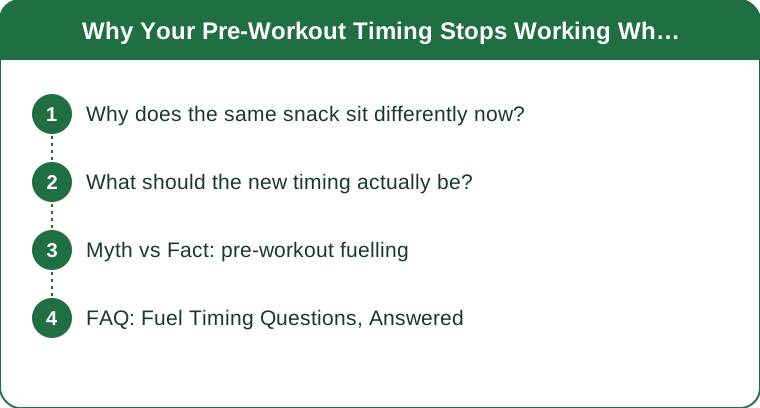
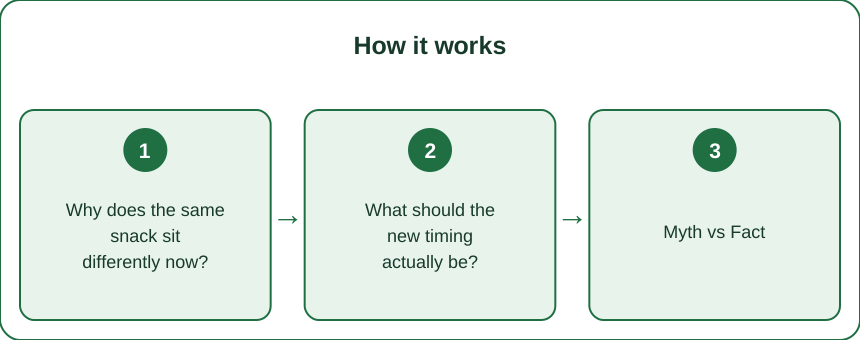
Why does the same snack sit differently now?
Gastric emptying is slower later in the day. Digestion follows a circadian rhythm, and the stomach empties measurably more slowly in the evening than in the morning. A snack that cleared in 45 minutes before a 7am session may take 75 minutes before a 6pm one.
Indoor training is usually more intense. Summer sessions outdoors tend toward steady aerobic work; autumn sessions indoors tend toward intervals and lifting. Higher intensity diverts more blood flow away from the gut, which slows digestion further and makes anything still in the stomach much more noticeable.
You have eaten more by then. A pre-workout snack at 5:30pm sits on top of lunch and possibly an afternoon snack. At 6:30am it sits on an empty stomach. The total load is completely different.
Cooler weather changes hydration. Reduced thirst means many people arrive at an evening session slightly dehydrated, which itself slows gastric emptying and produces the heavy feeling people blame on the food.
What should the new timing actually be?
Add 30 minutes to whatever worked in summer. If 45 minutes before a morning run was right, aim for 75 before an evening session of similar intensity.
Scale the interval to the size of the snack: roughly 30-60 minutes for something small and mostly carbohydrate (a banana, a rice cake with honey), 90-120 minutes for something with meaningful fat or protein, and 3 hours for a proper meal.
Reduce fat and fibre in the pre-session snack specifically. Both slow gastric emptying substantially. The high-fibre snack that is excellent at 3pm is the wrong choice at 5pm before a 6pm session.
Move carbohydrate earlier in the day. A larger lunch means the pre-session snack can be smaller, which solves the timing problem by making it a smaller problem.
For evening lifting specifically: 20-30g of easily digested carbohydrate about 45 minutes out is usually enough. People routinely over-fuel evening sessions because they are eating out of the day’s accumulated hunger rather than for the session.

Myth vs Fact: pre-workout fuelling
Myth: You need protein immediately before training. Fact: Total daily protein and the meal after training matter far more. Protein before a session mostly slows digestion.
Myth: Training fasted burns more fat. Fact: It shifts substrate use during the session, but 24-hour fat oxidation and body composition outcomes are largely unchanged. Choose based on comfort and performance, not on fat burning.
Myth: The anabolic window closes 30 minutes after training. Fact: The window is measured in hours, not minutes. Eating within a couple of hours is fine for almost everyone.
Myth: Sports drinks are necessary for a one-hour gym session. Fact: Below about 60-90 minutes of moderate work, water is sufficient for most people. Carbohydrate drinks earn their place in longer or genuinely hard sessions.
Myth: If food sits heavy, you should eat less. Fact: Usually you should eat the same amount earlier, or change the composition. Under-fuelling an evening session produces a worse workout and a much larger appetite afterwards.
FAQ: Fuel Timing Questions, Answered
What if I train straight after work with no gap?
Eat a small carbohydrate snack at around 3-4pm rather than at 5:30pm, and treat the post-session meal as the main one. Front-loading the interval is the only real solution when the gap does not exist.
Does coffee before an evening session cause problems?
Caffeine has a half-life of five to six hours, so a 5pm coffee is still substantially active at 11pm. If sleep is affected, switch to a smaller dose or move it earlier — a 2pm cutoff suits most people.
Should I eat differently for lifting versus cardio?
Slightly. Lifting tolerates a fuller stomach better than running does, because there is less mechanical jostling. The same snack that is fine before a squat session can be uncomfortable before intervals.
TL;DR:
- Gastric emptying is slower in the evening, and indoor sessions are usually more intense — both slow digestion.
- Add roughly 30 minutes to your summer pre-session interval.
- Cut fat and fibre in the pre-training snack; keep it small and carbohydrate-led.
- Shift carbohydrate earlier in the day so the pre-session snack has less work to do.
- Keep drinking despite lower thirst — mild dehydration slows digestion and mimics over-eating.
The food did not stop working. The clock moved.
Keep Reading
This article is for general informational purposes only and is not medical advice. Always consult a qualified health professional for guidance specific to you.