Fuel Timing When a Long Commute Sits Between Work and Training
Quick Answer: A long commute between work and training extends the gap since your last real meal and adds a period of complete inactivity, which is why people arrive both hungry and sluggish. The fix is a planned commute snack about sixty to ninety minutes before the session — mostly carbohydrate, low fat, low fiber, around 150 to 300 calories — rather than a large late lunch or an empty stomach and a heavy post-session meal.
You ate lunch at one. You leave work at six. You get to the gym at seven fifteen after ninety minutes on a train or in traffic, and the session is flat before it starts.
Six hours since food and ninety minutes of sitting is not the same problem as training in the evening, and the standard evening-workout advice does not solve it.

What is actually going wrong?
Three things, and only one of them is about calories.
The gap is longer than you think. People plan around the session time and forget the commute is on the wrong side of it. If lunch was at one and the session starts at seven fifteen, that is over six hours, and the last three of them were spent sitting.
Blood glucose has been drifting for hours. Not dangerously, but enough that concentration, mood and perceived effort are all measurably worse. The flat, unmotivated feeling in the changing room at seven is frequently this rather than fatigue from the day.
The sitting itself is a factor. A long period of complete inactivity immediately before exercise leaves you stiff, with reduced blood flow to the legs and a body that has effectively been told to power down. This is why the first ten minutes of a post-commute session feel considerably worse than the first ten minutes of a session you walked to.
And there is a compounding behavioral problem: having eaten nothing since one, many people either eat something large just before the session because they are ravenous, which sits badly, or skip food entirely and then eat an enormous meal at nine thirty, which affects sleep. Both are consequences of not planning the commute snack.
The good news: this is one of the more easily fixed problems in this whole area, because the commute is dead time you are already spending.
What should you eat, and exactly when?
The target: 60 to 90 minutes before the session, 150 to 300 calories, mostly carbohydrate, low in fat and fiber.
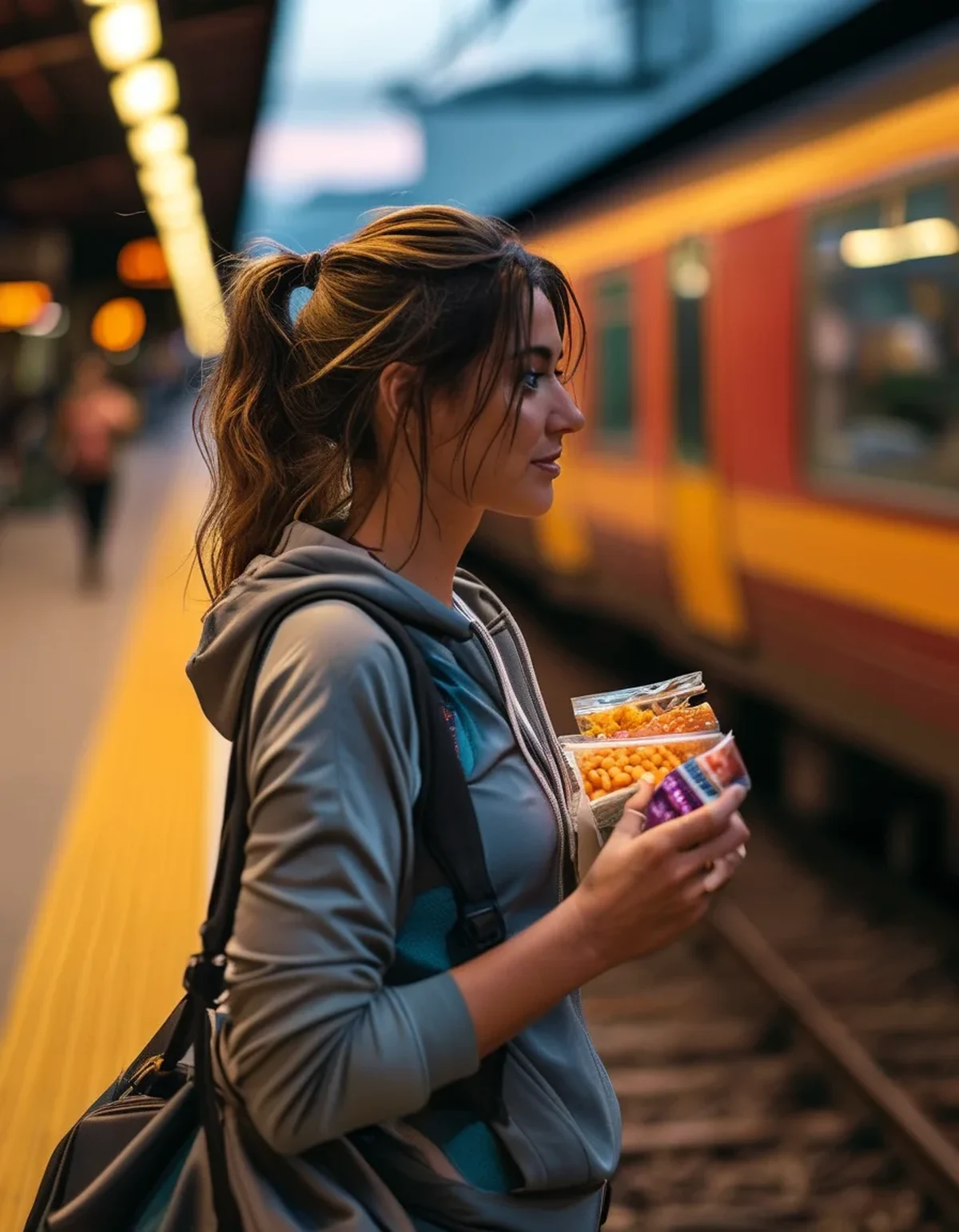
For most commutes that means eating on the train, in the car park before you set off, or at your desk right before you leave. The commute is the window — that is the useful reframing here.
Why mostly carbohydrate: it is what you will actually use, and it empties from the stomach fastest.
Why low fat and low fiber: both slow gastric emptying substantially, which is the direct cause of food sitting heavily during a session. This is the reason a handful of nuts, which feels like the sensible option, is one of the worse choices at this timing.
Things that work well: A banana. Almost purpose-built for this — portable, no packaging problem, digests fast. A cereal bar or flapjack, checking that it is not a high-fat nut-based one. Rice cakes or a plain roll. Dried fruit — dates, raisins, apricots — in small quantities. A carton of milk or a small yogurt drink if you want a little protein with it. A sports drink or diluted juice if you struggle to eat anything before training.
Things that work badly at this timing: nuts, cheese, anything fried, a large sandwich, a high-fiber bar, and a very large coffee on an empty stomach.
If you have less than 30 minutes: go smaller and simpler — half a banana, a few dates, or a drink with some carbohydrate in it. Small and close is better than large and close.
How do you fit it into the rest of the day?
The commute snack is one piece; the day around it matters.
Do not fix this by making lunch enormous. A very large lunch at one o’clock does not still be helping at seven, and it makes the afternoon worse. Normal lunch plus a planned snack beats a huge lunch and nothing.
Consider a mid-afternoon snack as well on long-commute days. Around four o’clock, something with protein — yogurt, a boiled egg, some cheese and fruit — takes the edge off so that the commute snack does not have to do all the work.
Plan the post-session meal before you leave in the morning. The realistic alternative to a plan is a large meal at ten at night, which affects sleep quality and therefore tomorrow. Something that is ready, or nearly ready, when you walk in is the whole solution. Anyone training after a long commute regularly should be batch cooking; there is no other version of this that works reliably.
Hydration is genuinely worse on commuting days. Most people drink less on a train or in a car — deliberately, because of the toilet problem — and arrive mildly dehydrated on top of everything else. A bottle finished during the commute is worth more than most of the food advice here.
Caffeine has a specific timing question. A coffee for the commute works well for the session and, at seven in the evening, is late enough to affect sleep for a large fraction of people. Caffeine has a half-life of around five hours, so a 6pm coffee is still substantially present at bedtime. If you need it, keep it small and make it the exception.
And the honest structural point: if this pattern is three or four days a week, morning training or training near work is worth considering. The commute snack makes a hard structure workable; it does not make it easy.
5 Mistakes People Make on Commute-Then-Train Days
1. Treating the commute as neutral time. It is the digestive window you need, and it is being wasted. This is the whole insight — everything else follows from it.
2. Eating nothing and calling it fasted training. Fasted training is a deliberate strategy with a rationale, usually applied to easy morning sessions. Arriving at seven in the evening having not eaten since one is not fasted training, it is just under-fueled, and hard sessions in that state are measurably worse.
3. Choosing a protein bar. Most are high in fat and fiber and are designed as meal replacements, which makes them slow to clear the stomach. Excellent after a session, poor thirty minutes before one.
4. Drinking the big coffee at six. It helps the session and costs the sleep, and the sleep costs tomorrow’s session. A small one, or none, and the trade is much better.
5. Not planning dinner. The single biggest determinant of whether evening training after a commute is sustainable over months is whether food is ready when you get home. Not motivation, not the program — the third mistake on this list is the most common and this is the most consequential.
FAQ: Commute Fueling Questions, Answered
What if I cannot eat on my commute — I drive, or it is packed?
Eat before you leave the office. The timing still works: eating at six for a seven fifteen session is inside the window. A banana at your desk as you shut down is the simplest version.
Does it matter if my session is strength rather than cardio?
Slightly less, because strength training relies less on immediate glucose availability, but the practical experience is very similar — under-fueled lifting at the end of a long day produces poor session quality and low motivation. The same snack applies.
Should I eat more if the session is over an hour?
If it is long and hard, yes, and consider taking something for during it — a drink with carbohydrate in it, or a banana between halves. Over roughly ninety minutes of hard work, in-session fueling starts to matter.
Is it better to just train in the morning?
For anyone whose commute makes this a fight three or four days a week, honestly yes, if the mornings are available. But the version you do consistently beats the version that is theoretically better, and a good commute snack makes the evening version work well enough to keep.
TL;DR:
- The problem is not the evening session, it is the six-hour gap plus ninety minutes of sitting immediately before it.
- Use the commute as the eating window: 150 to 300 calories, mostly carbohydrate, low fat and fiber, 60 to 90 minutes out.
- Bananas, cereal bars, rice cakes and dried fruit work; nuts, cheese and protein bars sit heavily.
- Add a mid-afternoon snack rather than making lunch enormous, and drink during the commute.
- Have dinner ready before you leave in the morning — that is what makes the pattern survivable long term.
The whole fix is one banana eaten at the right time in dead time you were already spending. It is a small change and it is usually the difference between a flat session and a normal one.
Keep Reading
This article is for general informational purposes only and is not medical advice. Always consult a qualified health professional for guidance specific to you.