Why the Post-Workout Window Matters Less Than You Were Told
Quick Answer: The 30-minute anabolic window is much wider than originally described - closer to several hours on either side of training for most people. Total daily protein intake matters far more than timing, with roughly 1.6 g per kg of bodyweight per day as the commonly cited target for people training regularly. Timing still matters in two specific cases: training fasted, and training twice in one day.
For about fifteen years, gym bags contained a shaker specifically so it could be drunk within half an hour of the last set. It turns out the deadline was considerably more relaxed than anyone was told.

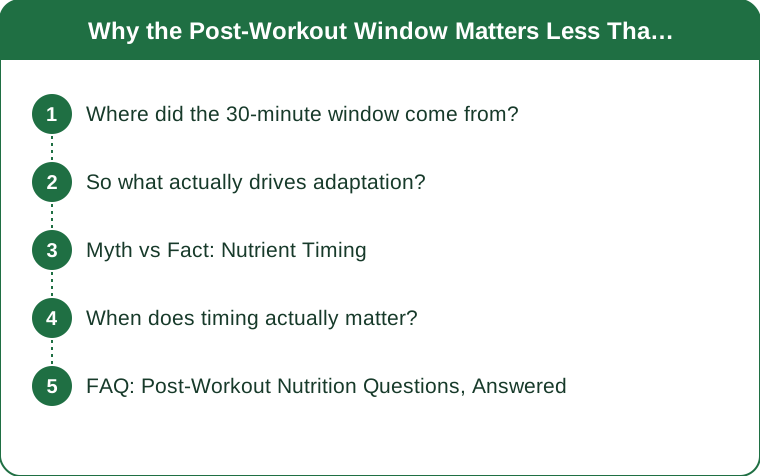
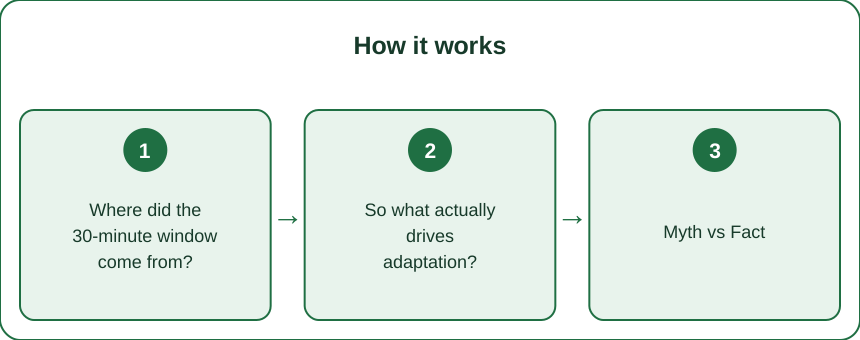
Where did the 30-minute window come from?
From real research that was interpreted more narrowly than it deserved.
Early studies used fasted training. Participants who trained without having eaten showed clear benefits from immediate post-workout nutrition. That result is genuine - but it applies to a fasted starting point, which most people are not.
Muscle protein synthesis is elevated for far longer than 30 minutes. After a resistance session, the elevation lasts on the order of 24 to 48 hours, with the largest response in the first several hours. A single half-hour slot was never the whole picture.
A pre-workout meal is still circulating. If you ate two hours before training, amino acids from that meal are still available during and after the session. The window effectively opened before you started, which is why the urgency to eat immediately afterward is lower than it sounds.
Subsequent research narrowed the effect. Analyses controlling for total daily protein found that timing effects largely disappeared once intake was matched - which is the finding that changed the recommendation.
So what actually drives adaptation?
Total intake, distribution across the day, and training itself - roughly in that order.
Total daily protein is the main lever. Around 1.6 g per kg of bodyweight per day is the commonly cited target for people training for strength or muscle, with some benefit up to about 2.2 g/kg for those in a calorie deficit. Hitting this consistently outweighs any timing detail.
Distribution across the day helps. Spreading protein into three to four servings of 25 to 40 g appears more effective than one large serving, because each feeding produces its own synthesis response.
Training quality and progression outrank both. The stimulus is what creates the adaptation; nutrition supports it. No timing arrangement compensates for a program that does not progress.
Total energy intake sets the ceiling. In a substantial deficit, building muscle is slow regardless of protein timing. In maintenance or a small surplus, it is much more responsive.
And sleep does more than most supplements. Chronically short sleep impairs recovery and body composition outcomes in a way that no post-workout shake addresses.

Myth vs Fact: Nutrient Timing
Myth: You lose your gains if you miss the 30-minute window. Fact: You do not. The elevated synthesis period runs for a day or more, and eating within a couple of hours is entirely sufficient for most training scenarios.
Myth: You must have a shake specifically. Fact: A shake is convenient and rapidly absorbed, and it is not required. A meal containing 25 to 40 g of protein does the same job. Convenience is the only real advantage of the powder.
Myth: Carbs must be consumed immediately to refill glycogen. Fact: Rapid refueling matters if you are training again within about 8 hours. With a full day between sessions, total daily carbohydrate is what matters and the timing is flexible.
Myth: Fasted training requires immediate post-workout food. Fact: This is the one case where timing genuinely does matter more - eat reasonably soon after a fasted session. But even here, soon means within an hour or two, not thirty minutes.
Myth: Protein above a certain amount per meal is wasted. Fact: The idea that only 20 to 25 g can be used per meal has been substantially revised. Larger doses produce a longer-lasting response rather than being discarded, so a large protein meal is not a waste.
When does timing actually matter?
Four situations, all of which are identifiable in advance.
1. Training fasted. If you train before eating - early morning sessions especially - eating within an hour or two afterward is genuinely worth prioritizing, because there is no circulating nutrition from a prior meal.
2. Two sessions in one day. Athletes training twice daily need rapid refueling between sessions, particularly carbohydrate. Here the classic timing advice holds fully.
3. Endurance sessions over about 90 minutes. Fueling during the session and refueling promptly afterward affects the next day’s session meaningfully. This is a timing-sensitive scenario in a way that a 45-minute strength session is not.
4. A long gap before the next meal. If your session ends at 7pm and you would otherwise not eat until the next morning, that gap is worth closing. This is not about a window - it is about total intake.
Practical version for everyone else: eat a normal meal containing protein within a couple of hours either side of training, hit your daily total, and stop watching the clock. The mental energy saved is worth more than the marginal effect you were chasing.
FAQ: Post-Workout Nutrition Questions, Answered
Do I need protein immediately after lifting?
Not immediately. Within a couple of hours is fine for most people, and a pre-training meal extends that further. Prioritize your daily total over the clock.
How much protein per day should I aim for?
Around 1.6 g per kg of bodyweight per day is a commonly cited target for people training regularly, with somewhat more useful when dieting. Spreading it across three or four meals is a reasonable structure.
Is a shake better than food?
Only in convenience and speed of absorption. If you can eat a meal, a meal is at least as good and generally more satiating.
What about training early in the morning?
This is the fasted case, where post-training nutrition matters more. Either eat something small beforehand, or plan to eat properly within an hour or two afterward.
This is general information, not medical or dietetic advice. Individual needs vary with health conditions, training load, and goals.
TL;DR:
- The anabolic window is hours wide, not 30 minutes - elevated muscle protein synthesis lasts 24 to 48 hours.
- Total daily protein (around 1.6 g/kg) matters far more than timing, spread across 3 to 4 servings.
- Timing genuinely matters when training fasted, training twice a day, or after long endurance sessions.
- A shake is convenience, not necessity - a meal with 25 to 40 g of protein does the same work.
The reason this is worth updating is not that the shake was harmful - it is that a lot of people organized their whole training schedule around a deadline that did not exist, and some of them skipped sessions because they could not make the window work. Eat properly across the day, train consistently, sleep enough, and the clock stops being a variable you have to manage.
Keep Reading
This article is for general informational purposes only and is not medical advice. Always consult a qualified health professional for guidance specific to you.