Why Eating Right Before a Workout Sometimes Backfires, Even With the Right Foods
Quick Answer: Even the right pre-workout foods can backfire if eaten too close to activity, because digestion diverts blood flow toward the gut right when working muscles need it most — the general guidance of leaving 2-3 hours for a full meal or 30-60 minutes for a small snack exists specifically to avoid that overlap, not just to pick the right macronutrients.
Most fuel-timing advice focuses heavily on what to eat and treats timing as a minor detail, when timing is often the actual variable causing the problem.

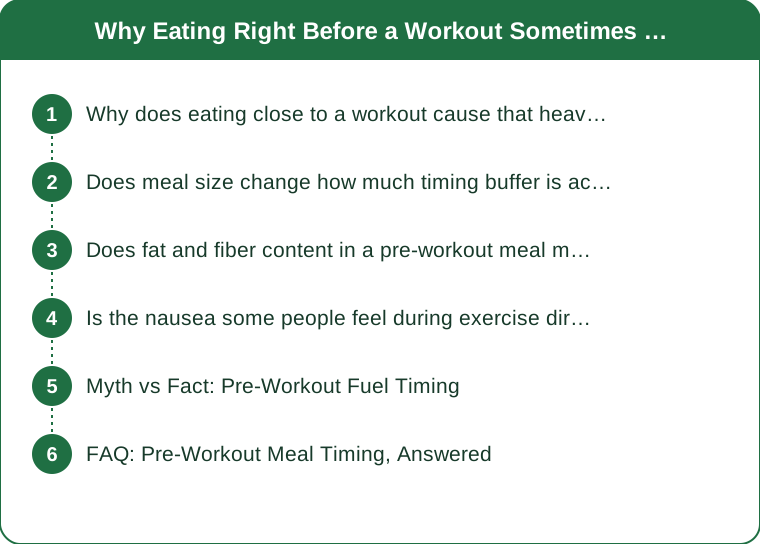
Why does eating close to a workout cause that heavy, sluggish feeling specifically?
During digestion, blood flow is redirected toward the digestive system to support nutrient absorption; starting exercise before this process has meaningfully progressed means the body is competing to send blood to both the gut and the working muscles simultaneously, which commonly produces the sluggish or uncomfortable feeling.
Does meal size change how much timing buffer is actually needed?
Yes, proportionally — a larger, more complex meal requires more digestion time before exercise than a small snack does, which is why general guidance separates full-meal timing (2-3 hours) from small-snack timing (30-60 minutes) rather than giving one blanket rule.
Does fat and fiber content in a pre-workout meal make the timing issue worse?
Yes — both fat and fiber slow digestion meaningfully, which is generally good for sustained energy over a longer period but specifically bad for a meal eaten close to activity, since slower-digesting food is still actively competing for blood flow when the workout starts.

Is the nausea some people feel during exercise directly tied to this same mechanism?
Often yes — exercise-induced nausea after eating too close to a workout is commonly linked to the same blood-flow competition and mechanical jostling of a partially digested meal during more vigorous movement, which is why the same food eaten with more buffer time typically doesn’t cause the same reaction.
Myth vs Fact: Pre-Workout Fuel Timing
Myth: The right food choice matters more than timing. Fact: even ideal food choices can cause digestive discomfort if the timing buffer is too short for that meal’s size and composition.
Myth: A pre-workout snack should always be eaten as close to the workout as possible for maximum energy. Fact: too close a timing window can cause the opposite of the intended effect, trading potential energy benefit for digestive discomfort.
Myth: Everyone needs the same timing buffer regardless of what they eat. Fact: buffer time should scale with meal size and fat/fiber content, not follow one fixed rule for every meal.
FAQ: Pre-Workout Meal Timing, Answered
What’s a safe general timing buffer for a small pre-workout snack?
Roughly 30-60 minutes before activity is a commonly recommended range for a small, simple snack, giving enough time to begin digestion without much of it still competing for blood flow at workout start.
Does morning workout timing change this guidance compared to afternoon workouts?
The underlying mechanism is the same regardless of time of day, though morning workouts sometimes involve a genuinely empty stomach after overnight fasting, which changes the calculation toward needing at least a small amount of fuel rather than training fully fasted for longer or higher-intensity sessions.
Is training on a completely empty stomach ever the better choice?
For some people doing lower-intensity or shorter sessions, training fasted works fine and avoids the timing issue entirely — but for longer or higher-intensity sessions, most people perform better with some appropriately timed fuel beforehand.
TL;DR:
- Digestion competes with working muscles for blood flow, which is the real timing issue
- Larger, more complex meals need proportionally more buffer time before exercise
- Fat and fiber slow digestion, which is bad specifically for a meal eaten close to activity
- Buffer time should scale with what and how much you’re eating, not follow one fixed rule
Keep Reading
This article is for general informational purposes only and is not medical advice. Always consult a qualified health professional for guidance specific to you.