The Pre-Workout Caffeine Timing Mistake That's Wrecking Your Sleep Without You Realizing It
Quick Answer: Caffeine has an average half-life of about 5-6 hours, meaning half the caffeine from a pre-workout coffee at 6pm is still in your system around midnight — enough to measurably disrupt sleep for many people. If you train in the evening, timing caffeine intake for at least 6-8 hours before bed, or switching to a caffeine-free pre-workout, preserves the performance benefit without the sleep cost.

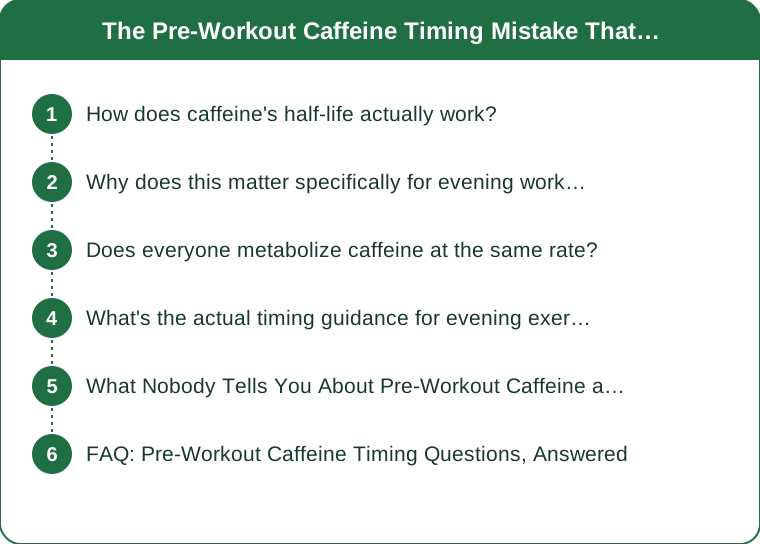
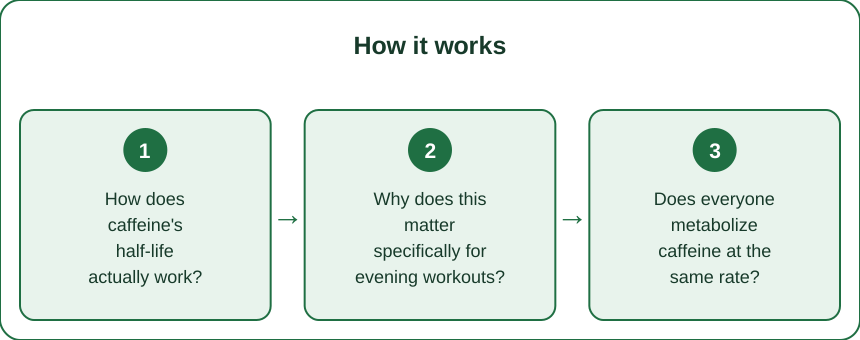
How does caffeine’s half-life actually work?
“Half-life” means the time it takes for half the caffeine dose to clear your system — at roughly 5-6 hours on average (though this varies by individual metabolism), a 200mg pre-workout dose still leaves about 100mg active in your body 5-6 hours later, and around 50mg still present after 10-12 hours.
Why does this matter specifically for evening workouts?
A pre-workout caffeine dose timed for a 6-7pm gym session means meaningful caffeine is still active at your typical bedtime, even if you don’t feel obviously “wired” — caffeine can disrupt sleep quality (specifically deep sleep stages) even without a noticeable jittery feeling.
Does everyone metabolize caffeine at the same rate?
No — genetic variation in the liver enzyme that breaks down caffeine (CYP1A2) means some people clear it significantly faster or slower than the average, which is part of why some people report no sleep issue from an evening coffee while others feel it well into the next morning.

What’s the actual timing guidance for evening exercisers?
Most sleep research suggests avoiding caffeine within 6-8 hours of bedtime as a general guideline — for a 10pm bedtime, that means a pre-workout caffeine dose ideally before 2-4pm, which rules out most standard pre-workout timing for an evening gym session.
What Nobody Tells You About Pre-Workout Caffeine and Sleep
Caffeine can disrupt sleep architecture even when you fall asleep at your normal time — studies show it can reduce deep sleep specifically, meaning someone can fall asleep on schedule but still wake up feeling less rested, without connecting it back to an evening pre-workout dose.
Caffeine-free pre-workout options (often using beta-alanine, citrulline, or creatine instead) provide some of the same performance-support benefits without the sleep-disrupting half-life issue, making them a reasonable swap specifically for evening training sessions.
Tolerance builds with regular daily caffeine use, meaning a habitual daily pre-workout coffee drinker may feel less obvious stimulation from the same dose than an infrequent user — but the sleep-disrupting effect on deep sleep architecture doesn’t necessarily follow the same tolerance pattern.
FAQ: Pre-Workout Caffeine Timing Questions, Answered
Does decaf coffee before an evening workout provide any benefit at all?
Decaf still contains a small amount of caffeine (usually under 5mg per cup) and lacks the meaningful stimulant effect of a full pre-workout dose, so it’s a poor substitute if performance benefit is the goal.
How much caffeine is actually in a typical pre-workout supplement?
Many pre-workout products contain 150-300mg per serving, roughly 1.5-3 cups of coffee worth, which is a substantial dose to have active at bedtime if timed too close to sleep.
Is it better to just skip caffeine before evening workouts entirely?
For people sensitive to caffeine’s sleep effects, yes — a caffeine-free pre-workout or simply training without one avoids the trade-off altogether. This is general information, not medical advice.
TL;DR:
- Caffeine’s roughly 5-6 hour half-life means a 6pm dose is still meaningfully active at midnight
- Evening workouts with a caffeine pre-workout can disrupt deep sleep even without feeling obviously wired
- Most sleep guidance suggests avoiding caffeine within 6-8 hours of bedtime
- Caffeine-free pre-workout options provide some performance benefit without the sleep trade-off
The pre-workout boost is real, but for evening exercisers, the sleep cost is often happening quietly in the background without ever being connected back to that afternoon dose.
Keep Reading
This article is for general informational purposes only and is not medical advice. Always consult a qualified health professional for guidance specific to you.