Fuelling a Workout That Just Moved to 6am
Quick Answer: When training moves to early morning, the question is not whether to eat but how much time you have. Under 30 minutes, take 15 to 30g of fast carbohydrate; 60 to 90 minutes, a small mixed meal; and if you genuinely cannot eat, easy sessions are fine fasted while hard sessions are not. The bigger change is the evening before - a proper evening meal with adequate carbohydrate does more for a 6am session than anything you eat at 5:45.
The most common mistake is keeping the old post-workout meal timing after moving the workout three hours earlier.
This is general information rather than medical advice.

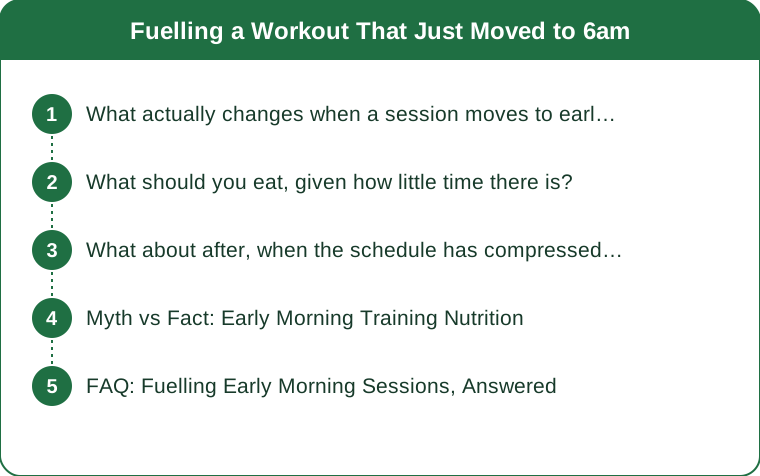
What actually changes when a session moves to early morning?
Glycogen status, digestion time and hormonal environment - and only one of them is a real problem.
Liver glycogen after an overnight fast. Muscle glycogen is largely preserved overnight. Liver glycogen is meaningfully depleted, and the liver is what maintains blood glucose. This matters for longer or harder sessions and matters very little for a 40-minute easy one.
Digestion time, which is the real constraint. Food takes time to leave the stomach, and exercise slows gastric emptying further. A 6am session means either eating at 4:30am, which nobody does, or eating something that clears quickly.
The hormonal picture. Cortisol peaks shortly after waking, and growth hormone and catecholamines are elevated. This favours fat oxidation, which is why fasted morning training feels manageable at easy intensities and falls apart at hard ones.
Body temperature and readiness. Core temperature is at its daily low in the early morning, which means longer warm-ups and lower peak performance. This is a real effect and independent of nutrition, and it is worth separating from fuelling questions.
What genuinely suffers without fuel:
- High-intensity work, which is glycogen-dependent
- Sessions over about 60 to 75 minutes
- Anything requiring concentration or skill
What is generally fine fasted:
- Easy aerobic work under an hour
- Mobility, technique and light strength work
- Walking at any duration
Which produces a simple rule. Match fuelling to session intensity, not to a philosophy. The fasted-versus-fed debate is largely resolved by asking what the session actually demands.
What should you eat, given how little time there is?
Three scenarios by available time, and the shortest one is more useful than people expect.
Under 30 minutes before - the most common early-morning case:
- 15 to 30g of fast-digesting carbohydrate, low in fat and fibre
- A banana, a slice of white toast with honey, a handful of dates, or a sports drink
- Avoid fat, fibre and large protein amounts, which all slow gastric emptying and cause discomfort
- Liquid clears faster than solid, which is why a drink works when food does not
60 to 90 minutes before:
- A small mixed meal of roughly 30 to 60g carbohydrate with a little protein
- Porridge with honey, toast with eggs, yogurt with fruit and granola
- Still keep fat and fibre moderate
If you genuinely cannot eat, which is common at this hour:
- Easy sessions: proceed fasted. This is fine and well tolerated
- Hard sessions: take something liquid. A sports drink or diluted juice sipped during the warm-up is tolerated by almost everyone and makes a substantial difference
- Even 15 to 20g of carbohydrate during a session improves performance in a way that surprises people
The evening before, which matters more than the morning does:
- A proper evening meal with adequate carbohydrate replenishes glycogen overnight. This is the single highest-value change when training moves early
- This is where people fail after a schedule change - the evening meal gets later, smaller and more rushed at exactly the point that morning training starts
- Adequate protein at the evening meal supports overnight recovery
Caffeine, which is worth getting right:
- 3 to 6mg per kg body weight is the effective range, roughly one to two strong coffees for most people
- 30 to 60 minutes before for peak effect
- On an empty stomach it hits faster and harder, and causes discomfort in some people. Test this on an easy session, not a hard one

What about after, when the schedule has compressed the whole morning?
Post-session eating gets squeezed, and this is where the transition actually costs people.
The pattern. Training moves to 6am, the session ends at 7, and the next thing is a school run or a commute. The post-workout meal that used to happen calmly at 9am becomes a coffee.
What the timing evidence actually says. The idea of a narrow anabolic window has been substantially revised. Total daily protein and carbohydrate intake matter far more than precise timing for most people. But eating within a couple of hours is still sensible, and the practical risk is not eating for five hours, which is what a compressed morning produces.
Realistic targets:
- 20 to 40g of protein within a couple of hours
- Carbohydrate proportional to what the session used - substantial after a hard or long one, modest after an easy one
- The 30-minute rule is not necessary, but the five-hour gap is a genuine problem
Practical solutions for a compressed morning:
- Prepare it the night before. Overnight oats, a prepared sandwich, boiled eggs - anything requiring zero morning decisions
- A liquid option in the car or on the train. A shake, milk, or a yogurt drink
- Eat at the destination. A prepared breakfast at work or after drop-off is often easier than one at home
Hydration, which is worse after a schedule change than people realise. You wake dehydrated after a night without fluid, train, and then start a busy morning. Front-load fluid on waking and carry a bottle, particularly while it is still hot.
The two-week adaptation. Appetite timing takes 1 to 2 weeks to re-entrain to a new schedule. Morning hunger often disappears entirely in the first week of early training, then returns. Eating on a plan rather than on appetite during that fortnight is the practical response - the hunger comes back once the rhythm settles.
Myth vs Fact: Early Morning Training Nutrition
Myth: Fasted morning training burns more fat, so it is better for body composition. Fact: It does increase fat oxidation during the session. Total energy balance over days determines body composition, and the difference has not translated into better outcomes in controlled trials.
Myth: You must eat within 30 minutes of finishing. Fact: The anabolic window is far wider than once believed. Total daily intake matters far more, though going five hours without eating after a hard session is a genuine problem.
Myth: If you cannot eat before, you should skip the session. Fact: Easy sessions are fine fasted. For hard sessions, a sports drink sipped during the warm-up is tolerated by almost everyone and makes a meaningful difference.
Myth: Protein is the priority before a morning workout. Fact: Carbohydrate is what limits performance in the short term, and protein slows gastric emptying. Save the protein for afterwards.
Myth: Coffee on an empty stomach is fine for everyone. Fact: It absorbs faster and hits harder without food, which suits some people and causes real discomfort in others. Test it before a hard session, not during one.
Myth: The morning meal is the important one when training moves early. Fact: The evening meal the night before does more. Overnight glycogen replenishment is what determines how a 6am session feels, and it is the meal that gets neglected during a schedule change.
FAQ: Fuelling Early Morning Sessions, Answered
Should I eat before a 6am workout?
It depends on the session. Easy work under an hour is fine fasted. For hard or long sessions, take 15 to 30g of fast carbohydrate, or sip a sports drink during the warm-up if you cannot eat solids.
What can I eat 20 minutes before?
A banana, white toast with honey, a few dates, or a sports drink. Keep fat, fibre and large protein amounts out, since all three slow gastric emptying.
Is fasted training better for fat loss?
It increases fat oxidation during the session, but controlled trials have not found better body composition outcomes. Total energy balance across days is what determines that.
What matters most when training moves early?
The evening meal the night before. Overnight glycogen replenishment does more for how a 6am session feels than anything you eat at 5:45.
How soon do I need to eat afterwards?
Within a couple of hours is sensible - 20 to 40g of protein plus carbohydrate matched to the session. The narrow 30-minute window has been substantially revised, but a five-hour gap is a real problem.
Why am I not hungry in the morning now?
Appetite timing takes one to two weeks to re-entrain to a new schedule. Eat on a plan rather than on appetite during that fortnight - the hunger returns once the rhythm settles.
TL;DR:
- Match fuelling to session intensity: easy work is fine fasted, hard work is not
- Under 30 minutes, take 15 to 30g of fast carbohydrate with minimal fat, fibre or protein
- If you cannot eat solids before a hard session, sip a sports drink during the warm-up
- The evening meal the night before matters more than anything you eat in the morning
- Prepare the post-session meal the night before, or a compressed morning turns it into a coffee
The session did not get harder. The fuelling schedule just stopped matching it, and both ends need to move together.
Keep Reading
This article is for general informational purposes only and is not medical advice. Always consult a qualified health professional for guidance specific to you.