Fuel Timing When Your Appetite Drops in Cooler Weather
Quick Answer: Appetite commonly shifts in autumn - some people eat more, and a substantial number find they want less around training, particularly in the morning. If training load has not changed, under-fuelling shows up as poor session quality, slower recovery and low energy within a couple of weeks. The practical answers are switching to warm and liquid options, moving the largest meal to when appetite is actually present, and treating pre-session fuel as scheduled rather than appetite-driven.
The sessions feel harder and you are eating less without deciding to.
Those two things are connected, and the second one caused the first.
This is general information, not medical advice.

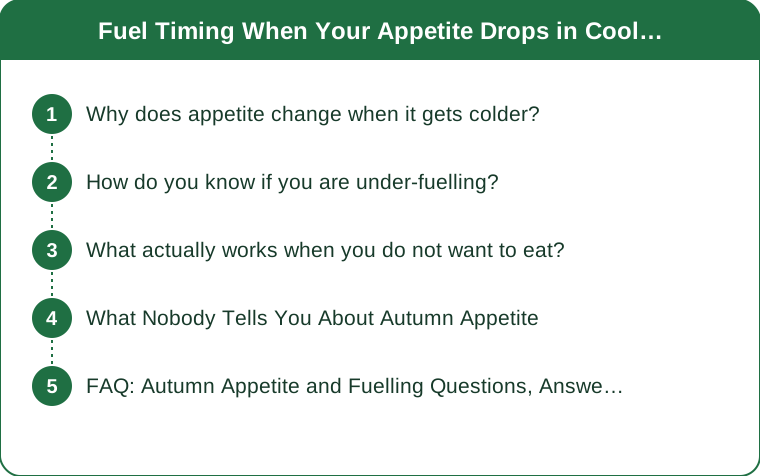
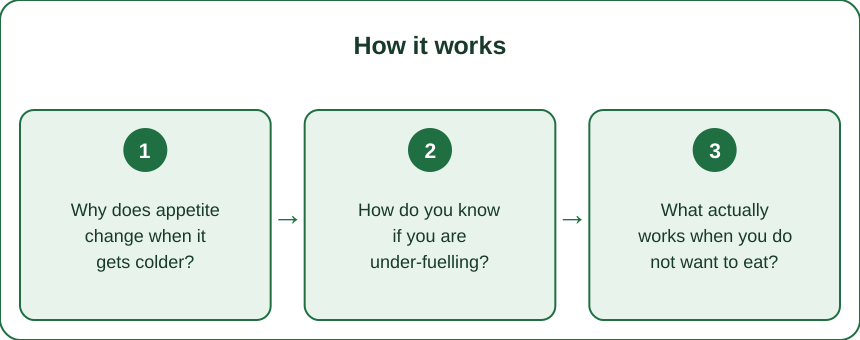
Why does appetite change when it gets colder?
Several things shift at once, and they do not all push in the same direction.
Meal timing shifts with light exposure. Circadian rhythms respond to daylight, and appetite has a circadian component. Later sunrise and earlier sunset move the whole pattern, which for many people means less interest in food early and more later.
Cold suppresses appetite acutely in the short term. Training in cold conditions frequently blunts hunger immediately afterwards, which is exactly when post-session fuelling is most useful.
Fluid intake drops, and thirst and hunger cues interact. People drink noticeably less in cool weather, and dehydration can suppress appetite as well as producing fatigue that gets attributed to other causes.
Routine changes. Autumn brings schedule shifts - training moves indoors or earlier, meals move around work patterns - and disrupted meal routine reduces intake more than people expect.
And there is a genuine split in how people respond. Some eat more in cold weather, drawn to warm and higher-energy food. Others eat less, particularly those who train in the morning. Both are normal, and this article is about the second group.
Why it matters: if training load stayed constant and intake dropped, you are running a deficit you did not choose, and the effects appear within one to two weeks as declining session quality.
How do you know if you are under-fuelling?
Session quality and recovery tell you before anything else does.
The earliest signal is performance declining across weeks while training stays the same. Not a single bad session - a trend. This shows up before weight changes and before you feel obviously hungry.
Other markers worth watching:
- Recovery taking longer. Soreness persisting into the next session for the same muscle group
- Feeling cold more than usual, including at rest, which is a common under-fuelling sign in cool weather
- Poor sleep, which can result from inadequate intake as well as causing it
- Losing motivation to train, which frequently reflects low availability rather than a psychological issue
- Getting ill more often, since immune function is affected by sustained low energy availability
For anyone tracking: a resting heart rate trending down alongside declining performance can indicate low energy availability, and it is easy to misread as improving fitness.
A simple check that works: log what you actually eat for three days, without changing anything. Most people are surprised by the drop from their summer pattern, and the gap is usually in breakfast and post-training.
Two things that need proper attention rather than self-management: appetite loss accompanied by other symptoms, and appetite loss in the context of any history of disordered eating. Both warrant a conversation with a doctor rather than a nutrition strategy.

What actually works when you do not want to eat?
Change the form of the food, and stop waiting for hunger.
Warm foods work when cold ones do not. This is the most reliable adjustment. Porridge instead of yoghurt, soup instead of salad, a warm drink with the meal. In cool weather the temperature of the food affects appetite more than the content does, and this is a genuinely easy swap.
Liquid calories bypass appetite more easily than solid ones. A smoothie or a milk-based drink is often manageable when a meal is not. This is particularly useful post-training, when appetite is most suppressed.
Move the largest meal to when you can actually eat. If mornings are impossible, stop trying to force breakfast. A larger lunch and a substantial evening meal is a legitimate distribution, provided the total is adequate and there is something before training.
Make pre-session fuel scheduled rather than appetite-driven:
- A small fixed amount at a fixed time before training - a banana, a slice of toast with honey, a small carbohydrate drink
- Timed by the clock, not by whether you feel like it
- Liquid if solid is unappealing
Fix hydration first, because it is often the actual cause. Warm drinks count, and a hot drink is easier to consume in cool weather than cold water. Herbal tea, broth and warm squash all contribute.
And on protein specifically: protein is the most satiating macronutrient, which makes it the hardest to eat when appetite is low. Spreading it across the day in smaller amounts works better than a large portion at one meal, and liquid sources are easier than solid ones.
What Nobody Tells You About Autumn Appetite
Five things that explain a lot of unexplained autumn fatigue.
Under-fuelling looks like overtraining. Poor sessions, slow recovery, low motivation and disturbed sleep are the classic overtraining picture, and inadequate intake produces all of them. People respond by resting more, which does not fix a fuel problem - and the training load was never the issue.
Feeling cold at rest is a fuelling signal. Being colder than usual, particularly indoors and at rest, is a recognised sign of low energy availability, and in autumn it gets attributed entirely to the weather.
The drop in fluid intake is larger than the drop in appetite. Ambient temperature strongly drives drinking, and nobody notices drinking less. Mild dehydration produces fatigue that looks like under-fuelling and suppresses appetite further, which compounds it.
Morning trainers are the most affected group. Appetite is lowest early, sunrise is later, and the pre-session window is the one where fuelling matters most. If you train before work in autumn, this is the specific gap to close.
The deficit is unintentional, which is what makes it persistent. A deliberate deficit gets monitored; an accidental one from a quiet appetite drop runs for weeks unexamined. Three days of honest logging is usually all it takes to find it, and almost nobody does it because nothing feels wrong enough to investigate.
FAQ: Autumn Appetite and Fuelling Questions, Answered
Is it normal to be less hungry in autumn?
For a substantial number of people, yes - light exposure shifts appetite timing and cold suppresses hunger acutely. Others eat more. Either is normal, and it only becomes a problem if training load stays constant while intake drops.
Should I force myself to eat?
For pre and post-training fuel, treat it as scheduled rather than appetite-driven - a small fixed amount at a fixed time. For meals generally, change the form to something warm or liquid rather than forcing volume.
What is the easiest thing to eat when I do not want food?
Warm liquid options - a smoothie, a milk-based drink, soup, porridge. Liquid bypasses appetite suppression more easily than solid food, and warm works better than cold in cool weather.
How do I know if this is affecting my training?
Look for performance trending down across weeks with unchanged training, recovery taking longer, and feeling cold at rest. Those appear well before weight changes or obvious hunger.
Could this be dehydration rather than appetite?
Quite possibly, and it is worth fixing first because it is easy. Fluid intake drops sharply in cool weather without anyone noticing, and mild dehydration both causes fatigue and further suppresses appetite. Warm drinks count.
When should I see a doctor about appetite loss?
If it is significant, persistent, accompanied by other symptoms, or if you have any history of disordered eating. A meaningful unexplained appetite change is worth a professional conversation rather than a self-managed strategy.
TL;DR:
- Autumn shifts appetite through light exposure, cold and routine change - some people eat more, some less
- If training load stayed the same and intake dropped, the deficit is unintentional and shows up within two weeks
- Under-fuelling looks exactly like overtraining, and resting more does not fix it
- Warm and liquid foods work when cold and solid ones do not
- Move the largest meal to when appetite actually exists, and treat pre-session fuel as scheduled
- Fluid intake drops more than appetite does, and dehydration suppresses appetite further
- Feeling cold at rest is a fuelling signal, not just the weather
Three days of honest logging usually finds the gap. Nobody does it because nothing feels wrong enough to check.
Keep Reading
This article is for general informational purposes only and is not medical advice. Always consult a qualified health professional for guidance specific to you.