How to Fuel When You Never Know When the Workout Will Start
Quick Answer: When you cannot predict the start time, stop trying to time a pre-workout meal and instead keep yourself in a permanently trainable state — eat every three to four hours, keep each meal moderate, and carry a fast fuel option for the twenty minutes before you actually start. Someone eating regularly can train hard with 20 to 30 minutes notice and no dedicated pre-workout meal at all.
Every fuel timing guide starts with the assumption that you know when you are training. Two hours before, thirty minutes before, immediately after.
If your training happens in whatever gap the day produces, that whole framework is unusable — and the good news is that it matters far less than it appears to.

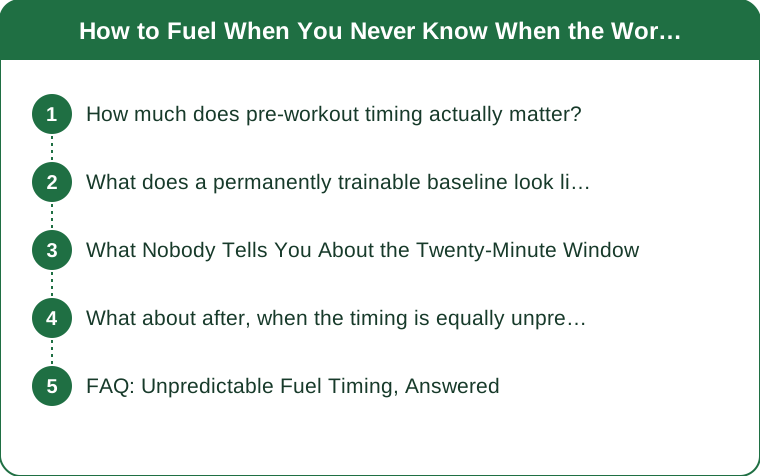
How much does pre-workout timing actually matter?
Considerably less than the volume of advice about it suggests, for most training most of the time.
For sessions under about 90 minutes, someone who has been eating normally has ample stored glycogen. Muscle glycogen is not depleted by a normal day of eating and living, and a 60-minute strength or conditioning session does not require a specifically timed meal beforehand. Performance differences between fed and moderately fasted states in that range are small for most people.
Where timing genuinely matters:
Sessions over 90 minutes, particularly endurance work, where glycogen depletion becomes a real limiter.
Very high intensity work, where even a small drop in available glucose is felt.
Anyone who has not eaten in six or more hours, where the issue is not glycogen but blood glucose and how you feel.
People managing blood sugar conditions, where this stops being a performance question and becomes a management one that belongs with a doctor.
The far bigger variable is the last few hours of eating in general, not the specific pre-workout meal. Someone who eats a reasonable lunch at 1pm can train well at 4pm, 6pm or 8pm without any dedicated preparation. Someone who skipped lunch cannot train well at any of those times regardless of what they eat in the twenty minutes beforehand.
Which produces the actual strategy for an unpredictable schedule: stop optimising the pre-workout window and optimise the baseline. Be someone who could train at any point, rather than someone who prepares to train at a point.
What does a permanently trainable baseline look like?
Regular, moderate, and boring — which is exactly why it works under an unpredictable schedule.
Eat every three to four hours. Not because meal frequency has magic properties, but because it means you are never more than a few hours from your last meal, and therefore never in the state where a session would go badly. This is the whole strategy in one line.
Keep individual meals moderate rather than large. A very large meal creates a two to three hour window where training is genuinely uncomfortable — blood flow is diverted to digestion and hard effort feels awful. Three moderate meals plus two snacks leaves far fewer unusable hours in a day than two large meals do.
Include protein at each one. 25 to 40g per meal supports the recovery side regardless of when training lands, and protein is the macronutrient least likely to cause problems if you end up training soon after eating.
Moderate the fat and fibre in the meals most likely to precede a session. Both slow gastric emptying substantially. A high-fat, high-fibre meal is a fine meal and a poor thing to have eaten 45 minutes before an unexpected session. If your training window is usually late afternoon, keep lunch moderate on both.
Stay hydrated continuously. Dehydration is one of the fastest ways to ruin a session and one of the slowest to fix. Drinking steadily through the day means you are never starting a session already down, which you cannot correct in twenty minutes.
The practical test of whether your baseline works: could you train hard, right now, with twenty minutes notice? If the honest answer is usually yes, the baseline is right. If it is usually no, the problem is the eating pattern, not the timing strategy.

What Nobody Tells You About the Twenty-Minute Window
You can do a surprising amount in the short notice you do get, provided you pick the right thing.
The window before a session is for fast, simple carbohydrate and nothing else. 15 to 30g — a banana, a couple of dates, a sports drink, a rice cake with honey. It absorbs quickly, tops up blood glucose, and rarely causes stomach problems.
Avoid protein, fat and fibre in that window. All three slow gastric emptying, and a stomach still working on them during hard effort is the most common cause of the specific misery people associate with eating before training.
Liquid beats solid when time is short. A drink with simple carbohydrate empties from the stomach substantially faster than the same carbohydrate in solid form. If you have ten minutes rather than thirty, drink it.
Caffeine works on a different clock and is worth knowing. Peak effect is around 45 to 60 minutes after intake, so a coffee taken as you leave is peaking mid-session rather than at the start. For an unpredictable schedule this is actually convenient — take it when you know you are going, and it lands during the work.
Keep a fixed kit. A banana, a pack of dates, a sachet of powder, in the bag, permanently. The failure mode of unpredictable training is not the absence of a strategy, it is the absence of the food when the gap appears. This is a logistics problem dressed up as a nutrition problem.
And if the gap appears and you last ate five hours ago: eat the fast carbohydrate, accept that the session will be slightly worse than optimal, and train anyway. A slightly underfuelled session that happens beats an optimally fuelled one that does not.
What about after, when the timing is equally unpredictable?
Easier, because the post-workout window is far more forgiving than the internet suggests.
The 30-minute anabolic window is largely overstated. Total daily protein intake and overall energy balance dominate. For someone who has eaten in the past few hours and will eat again within a few hours, there is no urgency at all.
Where it does matter: training genuinely fasted, training twice in one day, or endurance sessions that meaningfully depleted glycogen. In those cases, eating within an hour or two is worth prioritising because the recovery timeline is compressed.
The practical version for an unpredictable schedule: get 25 to 40g of protein and some carbohydrate into the next meal you eat, whenever that is. If the session ended at 9pm and the next meal would otherwise be breakfast, then yes, eat something — but a normal meal within a couple of hours covers it entirely.
Keep a shelf-stable option in the bag for the sessions that end at awkward times. A protein drink, a bar with real protein content, or a nut butter sachet with a banana. This is the same logistics point as before: the plan fails on availability, not on knowledge.
Sleep is the bigger recovery lever anyway. For someone with an unpredictable schedule, protecting sleep will do more for recovery than any post-workout timing precision. If the choice is between eating perfectly at 10pm and getting to bed on time, take the sleep.
Seasonally, as the days shorten, unpredictable training windows tend to shift later and indoors. Appetite also drops for many people in cooler weather, which makes the every-three-to-four-hours baseline harder to maintain by feel — it becomes something to keep an eye on rather than something that happens automatically.
This is general information, not medical advice. Anyone managing diabetes or another condition affecting blood glucose should work out fuelling around unpredictable training with their doctor.
FAQ: Unpredictable Fuel Timing, Answered
Can I train well without a dedicated pre-workout meal?
For sessions under 90 minutes, with normal eating through the day, yes. The pre-workout meal matters much less than the pattern of the previous eight hours.
What if I only get twenty minutes notice?
15 to 30g of fast carbohydrate, ideally liquid. That is the whole answer, and it works.
What if the gap opens up and I last ate six hours ago?
Eat the fast carbohydrate and train, accepting a slightly reduced session. If this happens regularly, the fix is the eating pattern, not the pre-workout strategy.
Should I keep something in my bag permanently?
Yes, and this is the highest-value change on the list. Dates, a bar and a shelf-stable protein drink. Replace them monthly so they are actually edible when needed.
Does training on an empty stomach damage muscle?
Not from a single session. Chronic under-eating alongside consistent training does cause problems, which is a different situation and worth taking seriously if it describes your pattern.
Is it worth training at all if the fuelling is imperfect?
Almost always yes. Consistency across months is the variable that determines results, and an unpredictable schedule already threatens that. Imperfectly fuelled sessions that happen are far more valuable than well-fuelled ones you skip because the timing was not right.
TL;DR:
- Stop timing the pre-workout meal. Build a permanently trainable baseline instead.
- Eat every three to four hours, moderate portions, 25 to 40g protein each, moderate fat and fibre before likely training windows.
- In the last twenty minutes: 15 to 30g of fast carbohydrate, liquid if time is short. No protein, fat or fibre.
- Caffeine peaks at 45 to 60 minutes, which suits a short-notice session well.
- Post-workout urgency is overstated — protein and carbohydrate at the next meal covers it. Protect sleep over precision.
The strategy for an unpredictable schedule is to make the question irrelevant: eat so that you could always train, and keep the fast option in the bag.
Keep Reading
This article is for general informational purposes only and is not medical advice. Always consult a qualified health professional for guidance specific to you.