Fuel Timing Is Different for Strength vs. Endurance Training — Here's How
Quick Answer: Strength athletes benefit most from protein-focused timing around lifts (20-40g within a few hours) since muscle repair is the priority, while endurance athletes need carb-focused timing before and during long efforts since glycogen depletion, not muscle damage, is the main limiter.
Generic fueling advice tends to average these two needs into one bland recommendation — a bit of protein, a bit of carbs, always the same ratio. But a 5k runner and a powerlifter are solving different problems, and their fueling should reflect that.

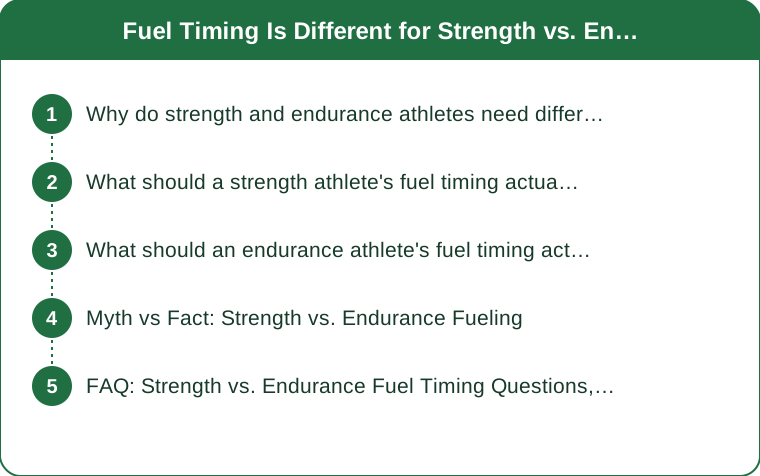
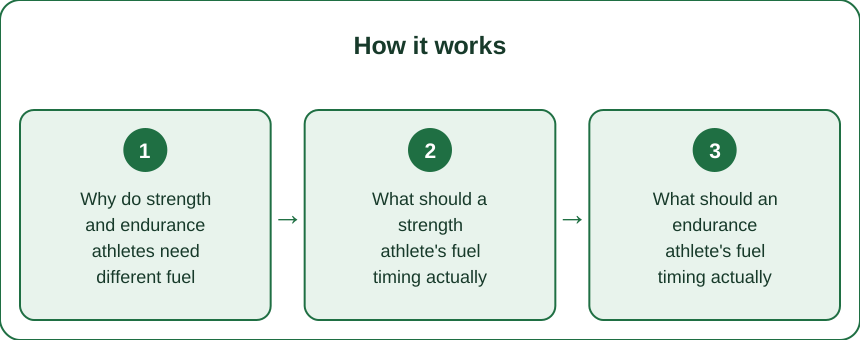
Why do strength and endurance athletes need different fuel timing?
Strength training causes localized muscle damage that needs protein and amino acids for repair — the limiting factor for progress is usually protein synthesis, not immediate energy availability, since most lifting sessions don’t fully deplete glycogen.
Endurance training, especially sessions over 60-90 minutes, burns through glycogen stores as the primary fuel source. The limiting factor there is carbohydrate availability, both during the effort and for the following day’s recovery — protein matters less in the moment than having enough carbs on board.
What should a strength athlete’s fuel timing actually look like?
- Pre-lift: A moderate meal 2-3 hours before, or a small protein-carb snack 30-60 minutes before if training fasted isn’t the goal
- During: Rarely necessary for sessions under 90 minutes — water is usually sufficient
- Post-lift: 20-40g protein within a few hours (the old “30-minute window” is outdated — the real window is closer to 4-6 hours), paired with moderate carbs to replenish the modest glycogen used
Total daily protein intake across the day matters more than the exact post-workout timing — hitting your daily target consistently outweighs precision timing.

What should an endurance athlete’s fuel timing actually look like?
- Pre-run/ride (60+ min effort): Carb-focused meal 2-3 hours before, topped up with a small carb snack 30-60 minutes before
- During (60+ min): 30-60g carbs per hour for efforts over an hour — this is where endurance fueling diverges most sharply from strength training, which rarely needs mid-session fuel
- Post-effort: Carbs are the priority for glycogen replenishment, with protein added for the muscle repair from the sustained effort — a 3:1 or 4:1 carb-to-protein ratio is a reasonable starting point
The during-workout fueling is the biggest difference from strength training — a 90-minute run without any fuel can meaningfully hurt the back half of the session in a way a 90-minute lift session usually won’t.
Myth vs Fact: Strength vs. Endurance Fueling
Myth: Every athlete needs the same 30-minute post-workout protein window. Fact: The urgent post-workout window is a myth for both groups — what actually matters is total daily protein for lifters and glycogen replenishment timing (same day) for endurance athletes.
Myth: Carb-loading is only for marathon runners. Fact: Any endurance effort over roughly 90 minutes benefits from some carb loading; strength training sessions, even long ones, rarely deplete glycogen enough to need it.
Myth: Lifters don’t need carbs, just protein. Fact: Carbs fuel the lifts themselves and replenish the glycogen used during high-volume training — cutting carbs too aggressively often shows up as strength plateaus, not just fatigue.
FAQ: Strength vs. Endurance Fuel Timing Questions, Answered
What about people who do both strength and endurance training?
Fuel around whichever session is that day — carb-focused before a long run, protein-focused after a heavy lift day — rather than trying to average the two approaches every day.
Does fasted training work for either group?
Fasted strength training is generally well-tolerated for sessions under an hour. Fasted endurance training beyond 60-90 minutes tends to hurt performance more noticeably, since glycogen depletion is the actual limiter there.
Which group needs to worry more about fuel timing overall?
Endurance athletes doing long sessions have a narrower margin for error — running out of carbs mid-effort has an immediate, obvious performance cost that a lifter running slightly under-fueled usually doesn’t feel in the same session.
TL;DR:
- Strength training needs protein-focused fueling for muscle repair; total daily intake beats exact timing
- Endurance efforts over 60-90 min need carb-focused fueling before AND during, not just after
- The old 30-minute anabolic window is outdated for both — the real window is hours, not minutes
- Fuel around the session type of the day if you do both, rather than one fixed daily approach
Match the fuel to the actual demand of the session, not a one-size-fits-all rule.
Keep Reading
This article is for general informational purposes only and is not medical advice. Always consult a qualified health professional for guidance specific to you.