How to Time Fuel for an Early Morning Workout Without Feeling Sick or Sluggish
Quick Answer: For an early morning workout, a small, easily digestible snack (like a banana, a few dates, or a small piece of toast) eaten 20-30 minutes beforehand works better than either a full meal or completely fasted training for most moderate-to-high-intensity sessions, since a full meal doesn’t have time to digest while training completely fasted can reduce performance in longer or harder sessions.
Early workouts don’t have to mean choosing between digestive discomfort and running on empty — a small, well-timed snack usually solves both problems.

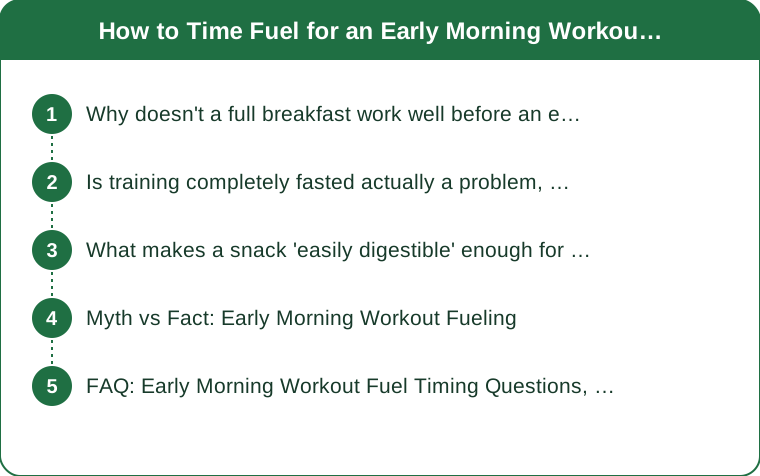
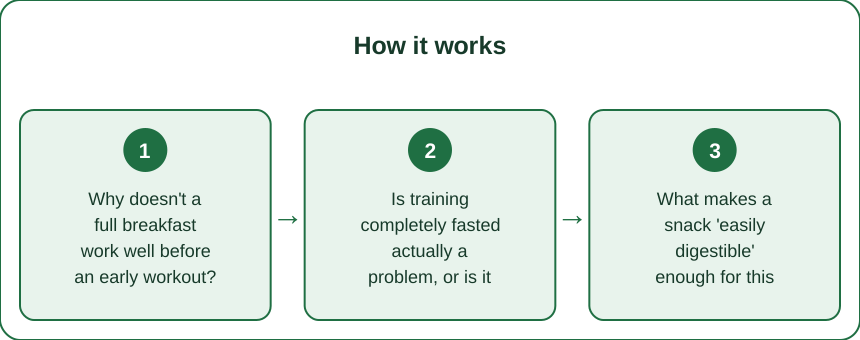
Why doesn’t a full breakfast work well before an early workout?
Digestion redirects blood flow toward the digestive system, and a full meal eaten shortly before exercise competes with the blood flow demands of working muscles, often causing sluggishness, cramping, or nausea during the workout — this effect is more pronounced the shorter the gap between eating and starting exercise.
Is training completely fasted actually a problem, or is it fine?
For lower-intensity, shorter sessions (a light walk, gentle yoga), fasted training is generally fine for most people, but for longer or higher-intensity sessions, overnight fasting can leave glycogen stores lower than ideal, sometimes resulting in reduced performance, earlier fatigue, or lightheadedness partway through — a small pre-workout snack specifically addresses this without requiring a full meal.

What makes a snack ‘easily digestible’ enough for this specific window?
Foods that are simple in composition — moderate-to-high in easily accessible carbohydrate, low in fat and fiber — digest fastest, since fat and fiber both slow digestion meaningfully, which is counterproductive in a short pre-workout window. Bananas, dates, a small piece of toast, or a small glass of juice all fit this profile well.
Myth vs Fact: Early Morning Workout Fueling
Myth: it’s always best to train completely fasted for early workouts. Fact: this depends heavily on session length and intensity — fasted training works fine for gentler sessions but can hurt performance in longer or harder ones. Myth: any pre-workout snack works as long as it’s small. Fact: fat and fiber content matter even in small snacks, since both slow digestion in ways that can still cause discomfort during a short pre-workout window.
FAQ: Early Morning Workout Fuel Timing Questions, Answered
Is it necessary to eat something before every early morning workout?
Not necessarily for shorter or lower-intensity sessions, where many people tolerate fasted training fine — the need for a pre-workout snack increases with session length and intensity.
How much water should be consumed alongside an early morning pre-workout snack?
A moderate amount (roughly a cup) alongside the snack helps with digestion and rehydrates after overnight fluid loss, without the discomfort of a large volume of fluid right before exercise.
What should be eaten immediately after an early morning workout if breakfast will be delayed?
A small recovery-focused snack with some protein and carbohydrate (like yogurt with fruit) bridges the gap well if a full breakfast won’t happen until later, helping support recovery without requiring an immediate full meal.
TL;DR:
- A small, easily digestible snack 20-30 minutes before an early workout beats both a full meal and full fasting
- Full meals don’t have time to digest and can cause discomfort during exercise
- Completely fasted training is fine for gentle sessions but can hurt longer or harder ones
- Low-fat, low-fiber, carbohydrate-forward snacks digest fastest in this short window
A banana or a few dates before an early workout usually solves both the sluggishness and the digestive-discomfort problem at once.
Keep Reading
This article is for general informational purposes only and is not medical advice. Always consult a qualified health professional for guidance specific to you.