Does the Post-Workout Window Actually Exist?
Quick Answer: The narrow 30-minute anabolic window is not supported by current evidence. Muscle protein synthesis stays elevated for 24 hours or more after resistance training, and total daily protein intake matters far more than timing. The window is real but wide - a few hours either side of training is fine for most people. The exception is glycogen replenishment for athletes training twice in the same day, where timing genuinely matters.
Hit your daily protein target and stop setting a timer.

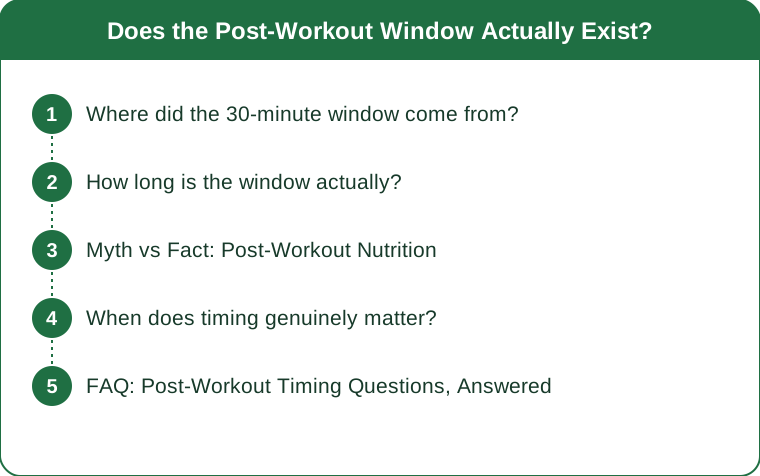
Where did the 30-minute window come from?
From real research that was over-extrapolated, which is a common pattern.
The original studies driving the idea were largely conducted in fasted subjects, and often looked at endurance exercise and glycogen resynthesis rather than muscle protein synthesis. In a fasted state, immediately post-exercise feeding does produce a measurably better response than delayed feeding - because the alternative is remaining in a catabolic, fasted state.
That finding got generalised into a universal rule for everyone regardless of what they had eaten beforehand.
The glycogen research was also specific. Muscle glycogen resynthesis is genuinely faster in the first couple of hours after exhaustive endurance exercise, when the muscle’s glucose uptake is elevated and insulin-independent transport is temporarily upregulated. That is a real effect - it just applies to athletes who need to be fully refuelled within hours, not to someone lifting three times a week.
The more recent picture is quite different. A frequently-cited meta-analysis examining protein timing found that when total daily protein intake was controlled for, the apparent benefit of immediate post-workout protein largely disappeared. Total intake was doing the work, and timing was a confound.
So the honest history is not that researchers were wrong. It is that a specific finding under specific conditions became a general rule under all conditions, and the general rule did not hold up.
How long is the window actually?
Long enough that most people never need to think about it.
Resistance training elevates muscle protein synthesis for an extended period - commonly reported as at least 24 hours, and up to 48 hours in less-trained individuals. Throughout that period, the muscle is more responsive to available amino acids than it would be at rest.
That is a very different picture from a 30-minute door slamming shut. It means a meal eaten three hours after training is landing squarely in a period of elevated synthesis.
What the evidence supports as practically useful:
- Total daily protein is the dominant variable. Current recommendations for those training for muscle gain generally land around 1.6 to 2.2 grams per kilogram of bodyweight per day. Hitting that number matters far more than when any individual portion arrives.
- Distribution across the day helps modestly. Spreading intake across roughly 3 to 5 meals of 25 to 40 grams each appears somewhat better than one or two large servings, because each feeding stimulates a synthesis response.
- A meal within a few hours either side of training is sensible, not urgent. If you ate a protein-containing meal two hours before training, you have amino acids circulating during and after the session already.
- Training fasted changes it somewhat. If you train first thing having eaten nothing since the previous evening, eating reasonably soon afterward is more useful, because you are genuinely in a depleted state.
The realistic summary: eat enough protein across the day, in a few reasonably-sized servings, and one of them somewhere near your training. That is the entire protocol.

Myth vs Fact: Post-Workout Nutrition
Myth: If you do not eat within 30 minutes, the session is wasted. Fact: Muscle protein synthesis remains elevated for 24 hours or more. A session is not wasted by a delayed meal. This claim has caused a remarkable amount of unnecessary anxiety and sold a great deal of powder.
Myth: A protein shake is better than food after training. Fact: It is faster and more convenient, not better. Whole food protein produces a slower but sustained amino acid release, and some evidence suggests whole-food sources may be equally or more effective for the overall response. A shake is a practical tool for hitting a daily target, not a superior mechanism.
Myth: You need carbohydrate with protein post-workout to spike insulin. Fact: Protein alone raises insulin sufficiently to support the response, and adding carbohydrate to a protein feeding does not appear to further increase muscle protein synthesis. Carbohydrate post-training matters for glycogen, which matters if you are training again soon. For a once-daily lifter, it is a total-intake question rather than a timing one.
Myth: The window matters more as you get older. Fact: Age changes the picture, but in the direction of dose rather than timing. Older adults show anabolic resistance - they need a larger protein dose per meal, commonly cited as around 40 grams versus 20 to 25 for younger adults, to produce a comparable synthesis response. The relevant adjustment is bigger servings, not faster ones.
When does timing genuinely matter?
Three specific situations, and outside them it is close to irrelevant.
Training twice in the same day. This is the clearest case. If you have a hard session in the morning and another in the evening, glycogen replenishment between them is time-limited and genuinely constrained. Here the classic guidance applies - carbohydrate intake in the region of 1 to 1.2 grams per kilogram per hour in the first few hours, with some protein. Athletes in two-a-day training blocks are the population the original research was actually about.
Training fasted, particularly early morning. If your last meal was 12 or more hours ago, you are in a genuinely depleted state and post-training feeding is more consequential. Not urgent to the minute, but within an hour or so is reasonable.
Endurance events with a short turnaround. A tournament, a stage race, a two-day event. Same glycogen logic.
Outside those, the useful hierarchy for anyone training for general fitness or muscle gain is:
- Total daily protein, around 1.6 to 2.2 g/kg. By far the largest factor.
- Total daily energy intake, appropriate to the goal. Second largest.
- Distribution across 3 to 5 servings.
- Timing relative to training. A distant fourth, and only worth optimising once the first three are consistently handled.
Most people trying to optimise number four have not solved number one, which is where the actual gains are. This is general information, not medical or dietetic advice.
FAQ: Post-Workout Timing Questions, Answered
Should I still have a shake after training?
If it helps you hit your daily protein target, absolutely - convenience is a legitimate reason and adherence beats optimisation. Just do not treat it as time-critical, and do not add it on top of an already-adequate intake in the belief that the timing makes it more effective.
What if I train in the evening and then sleep?
A protein-containing meal in the evening is worth having. There is reasonable evidence that pre-sleep protein - around 30 to 40 grams of a slower-digesting source like casein or a dairy food - supports overnight muscle protein synthesis. This is one of the few timing interventions with decent support.
Does this apply to fat loss as well as muscle gain?
The timing principles are the same, and adequate protein matters arguably more in a calorie deficit, where it helps preserve lean mass. Total intake and distribution again dominate; timing relative to training is a minor factor.
Is there any harm in eating immediately after training?
None at all, beyond occasional digestive discomfort if you eat a large meal while still elevated. If you prefer it and it fits your day, keep doing it. The point is that it is optional, not that it is wrong.
TL;DR:
- The 30-minute anabolic window came from fasted-subject and endurance-glycogen research that was over-generalised.
- Muscle protein synthesis stays elevated for 24 hours or more after resistance training - the window is real but wide.
- Total daily protein at roughly 1.6 to 2.2 g/kg is the dominant variable; spread it across 3 to 5 servings of 25 to 40g.
- Timing genuinely matters for two-a-day training, fasted early-morning sessions, and short-turnaround endurance events.
- Older adults need a larger dose per meal, around 40g, rather than faster timing.
Most people optimising timing have not yet solved total intake, which is where the actual result is. This is general information, not medical or dietetic advice.
Keep Reading
This article is for general informational purposes only and is not medical advice. Always consult a qualified health professional for guidance specific to you.